


Note: This is my Mea Culpa for briefly posting the first version of this article yesterday. I had worked on it for a long time and was eager to share it. In my haste, I failed to ensure the numbers were correct. For that, I am sorry. The retracted version did not reflect reality, and I’m angry with myself for letting it go public.
I’ve reworked the numbers, validated the data, and have a new article with a less rosy outlook than the previously published one.
What tipped me off to the errors in the article was the slew of passionate racers upset that their favorite local race was wrongly excluded from the top 25 list. I completely understand the frustration and appreciate the passion. I have fixed that chart, and it now accurately reflects race size.
The interesting point is that what people marked as the biggest mistake in the article—the absence of certain races in the Top Events list—was not even close to the most substantial data error the article relied on. That error involved post-pandemic results data, which inadvertently included disciplines other than cyclocross. That inclusion wildly inflated post-pandemic participant numbers. In my brain, I knew the sport contracted, but the (erroneous) numbers I compiled told a different story, and my heart ran with it. If I had stepped back, I should’ve realized something wasn’t right and not put that message out into the world.
That said, this exercise is still valuable, even if it leaves us with a work in progress rather than a flourishing sport. We can review our progress, assess challenges, and continue working to revitalize the sport. I apologize again for my misstep. No more early April Fools jokes—here is the revised, more accurate article. Thanks. -Bill
Since the 2025 U.S. Cyclocross National Championships ended, I’ve been trying to write a long narrative piece about the state of American cyclocross and how Nationals has changed over the past two decades. The more data I pulled, the less that long narrative rang true. So instead of pearl-clutching over whether things are the way they used to be, I decided to dig into the numbers to figure out where participation in the sport has changed1.
For this deep dive, and with the help of Colin Reuter’s treasure trove of CrossResults data, I looked at Nationals race-start totals from 2006 through 2025, selected championship-category data, age-bracket and large-race trend data, and a 2025 comparison of major regional events. There are certainly limits to the dataset that keep us from making perfect comparisons, so collect your grains of salt now and take them with you as you read ahead.
Before we use these statistics to make sweeping proclamations, let’s review what the data does not show. First, we don’t know how many unique riders were at an event. Someone could have raced twice in a day and multiple times over an extended weekend event or championship. For that reason, the data counts “race starts” or logged results rather than unique “racers.” On the Nationals side, some championship categories did not exist across the full timeline, especially on the women’s side. The age-bracket file is also its own slice of the data, so those raw counts should be compared within that file rather than directly against the yearly results totals. Age estimates are based on grouped brackets, not exact birthdates. And factors such as venue location, weather, schedule, and the pandemic have affected race attendance over the years.
With that out of the way, let’s get into the numbers.
In short, U.S. cyclocross endures but is smaller, older, and more dispersed post-pandemic, with less focus on large events like Nationals.
Cyclocross Is Not Dead
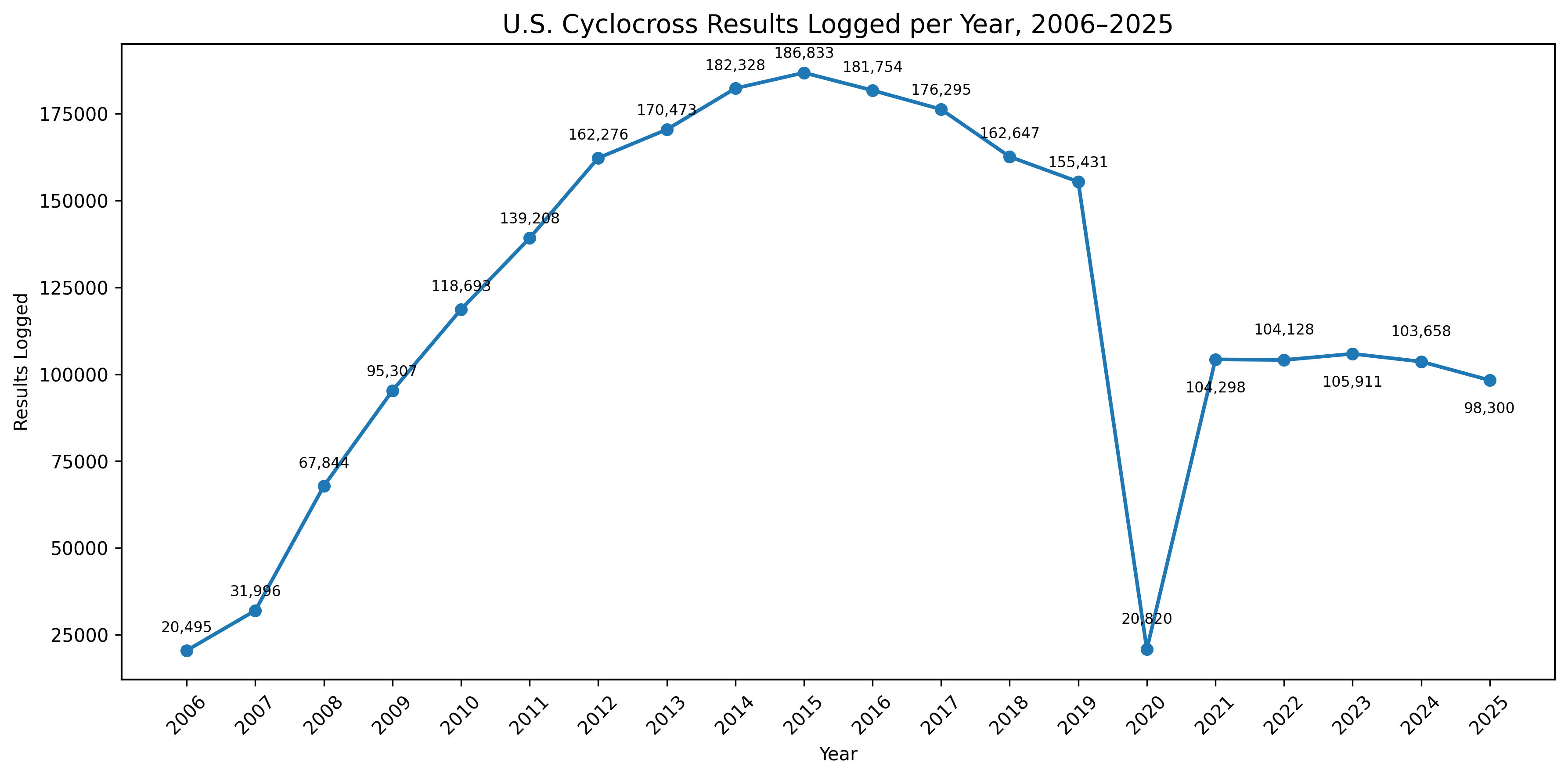
Using CrossResults totals, U.S. cyclocross results grew from 20,495 in 2006 to a peak of 186,833 in 2015. By 2019, the total had dropped to 155,431, and in 2025, it stood at 98,300.
In 2025, numbers were 47 percent below the 2015 peak, 37 percent below 2019, and seven percent below 2023. Numbers bottomed out at 20,820 in 2020 due to the pandemic. The sport rebounded to just over 104,000 results per year from 2021 to 2024, then slipped again in 2025.
Cyclocross isn’t dead yet, but a return to pre-pandemic numbers remains a work in progress. A sport with 98,300 logged results in 2025 is not dead. However, the corrected top-line numbers do not support a rosier outlook. The sport is smaller than at its peak, and participation is more dispersed than before.
Cyclocross Has Entered Its Middle Age
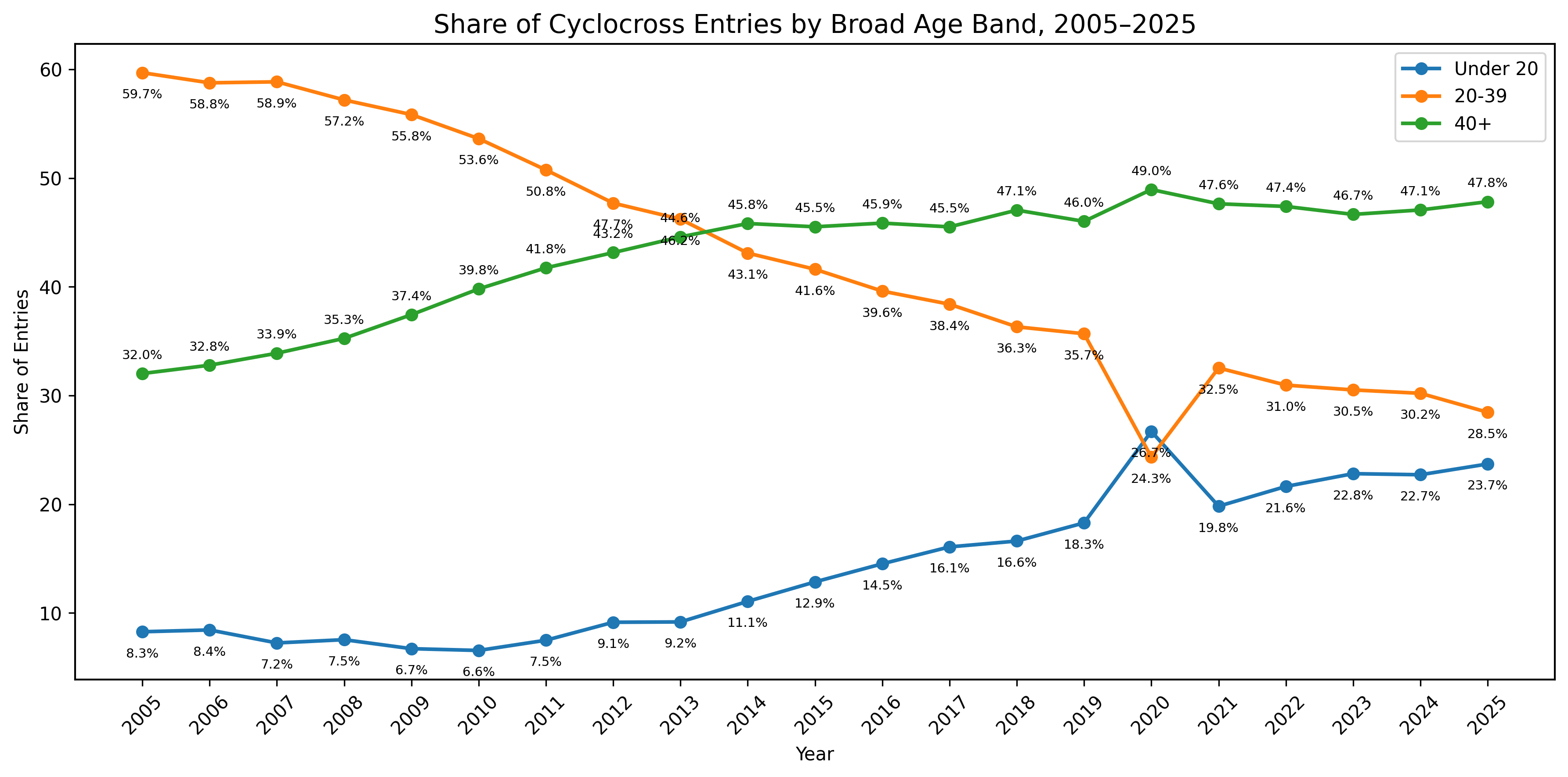
The biggest long-term shift is not in total volume but in age. Over time, the bell curve of cyclocross participation has shifted to the right. Riders who once packed the 30-to-39 field now show up more heavily in the 40-to-49 and 50-to-59 brackets. Meanwhile, the younger end of the adult field has thinned out.
From 2005 through 2012, the largest single age bracket in this file was 30-39. Beginning in 2013, the 40-49 bracket became the dominant bracket in most years and was again the largest in 2025, with 10,282 entries. The 30-to-39 bracket was second at 9,200, followed by the 50-to-59 bracket at 9,071.
In 2005, riders 40 and older accounted for 32 percent of all recorded entries in the age-bracket file. By 2015, that share had climbed to just over 45 percent, and by 2025, it stood at close to 48 percent. While this is not an outright majority, it nevertheless marks a major shift in the center of the sport.
For riders 50 and older, entries increased from 578 in 2005 to 12,597 in 2015 and 13,747 in 2025. Their share of all entries rose from 6% in 2005 to 17% in 2015 and 27% in 2025.
This trend continues for the oldest participants: entries from riders 60 and older grew from 89 in 2005 to 1,910 in 2015 and 4,676 in 2025. Their share of total entries rose from just under one percent to 2.6 percent in 2015 and 9.3 percent in 2025.
At the same time, the center of gravity shifted from the ages that fueled the sport’s boom years. Riders aged 20 to 39 made up nearly 60 percent of entries in 2005; by 2015, that dropped to 41 percent, and by 2025, to 28 percent.
A clear sign of this demographic shift is that, in 2015, riders 50 and older first surpassed those aged 20 to 29. Excluding the pandemic-distorted 2020 season, they also overtook the 30-to-39 bracket by 2021. In 2025, riders 50 and older logged 13,747 entries, compared to 9,200 for those aged 30 to 39.
Younger Riders Have Not Disappeared
Despite the sport’s overall aging, participation among riders under 20 has also grown, from 800 entries in 2005 to 9,508 in 2015 and 11,909 in 2025. Its share of total entries also rose from 8.3 percent in 2005 to 13 percent in 2015 and close to 24 percent in 2025.
The sport is aging not because youth participation has vanished, but because the 20-to-39 core age group has shrunk while older riders keep racing in meaningful numbers.
The End of the Big Race Era
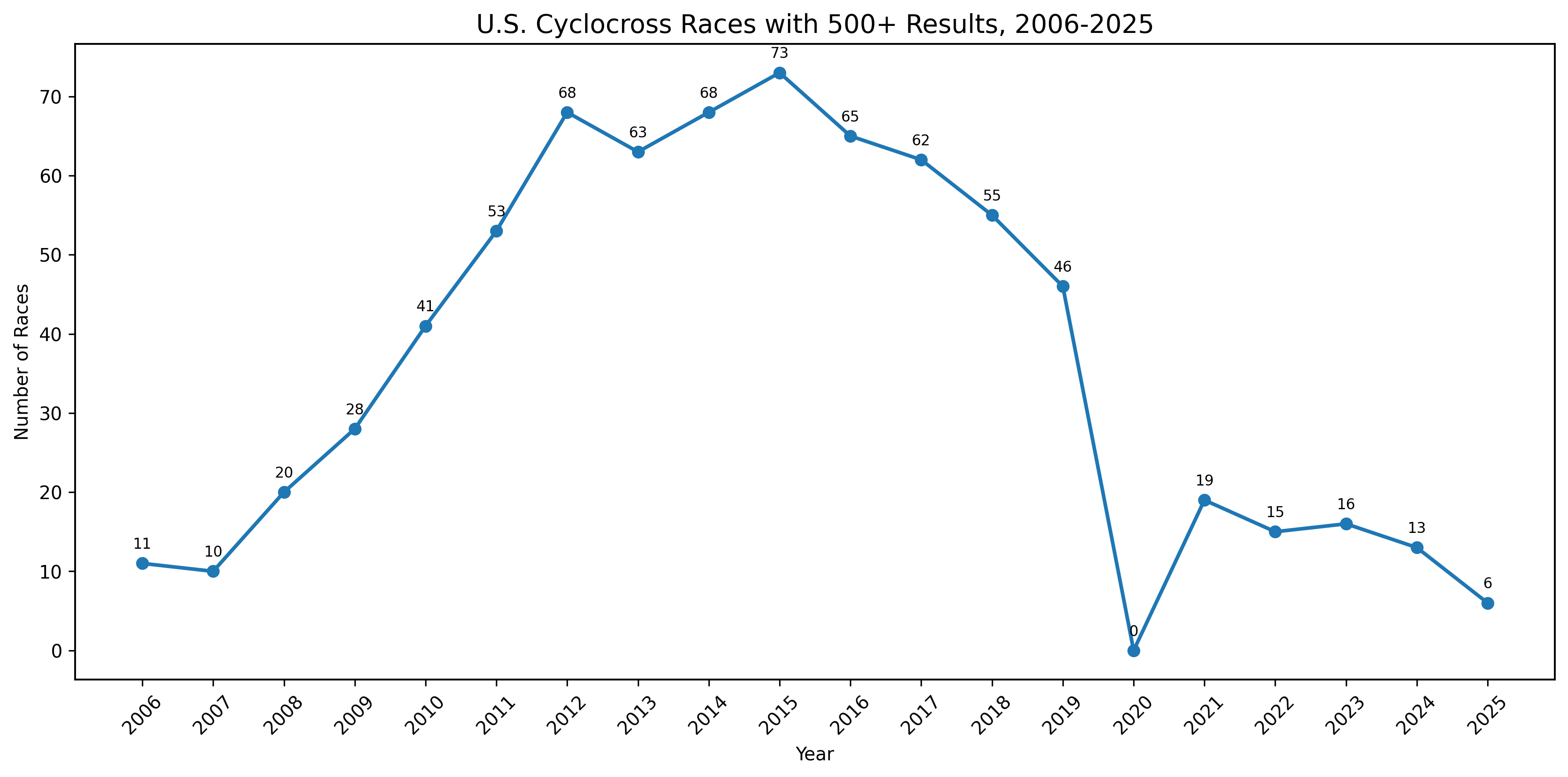
The other big story is the disappearance of the big race day.
In 2015, there were 73 single-day races in the U.S. with more than 500 recorded results. In 2019, that number was down to 46 races. In 2025, it was just six. That is a nearly 92 percent drop from 2015 to 2025 in the number of U.S. races with more than 500 recorded results.
People are still racing cyclocross. They are just doing it in smaller settings. It’s quite possible the return to grassroots cyclocross already happened without anybody noticing.
Nationals Downsized
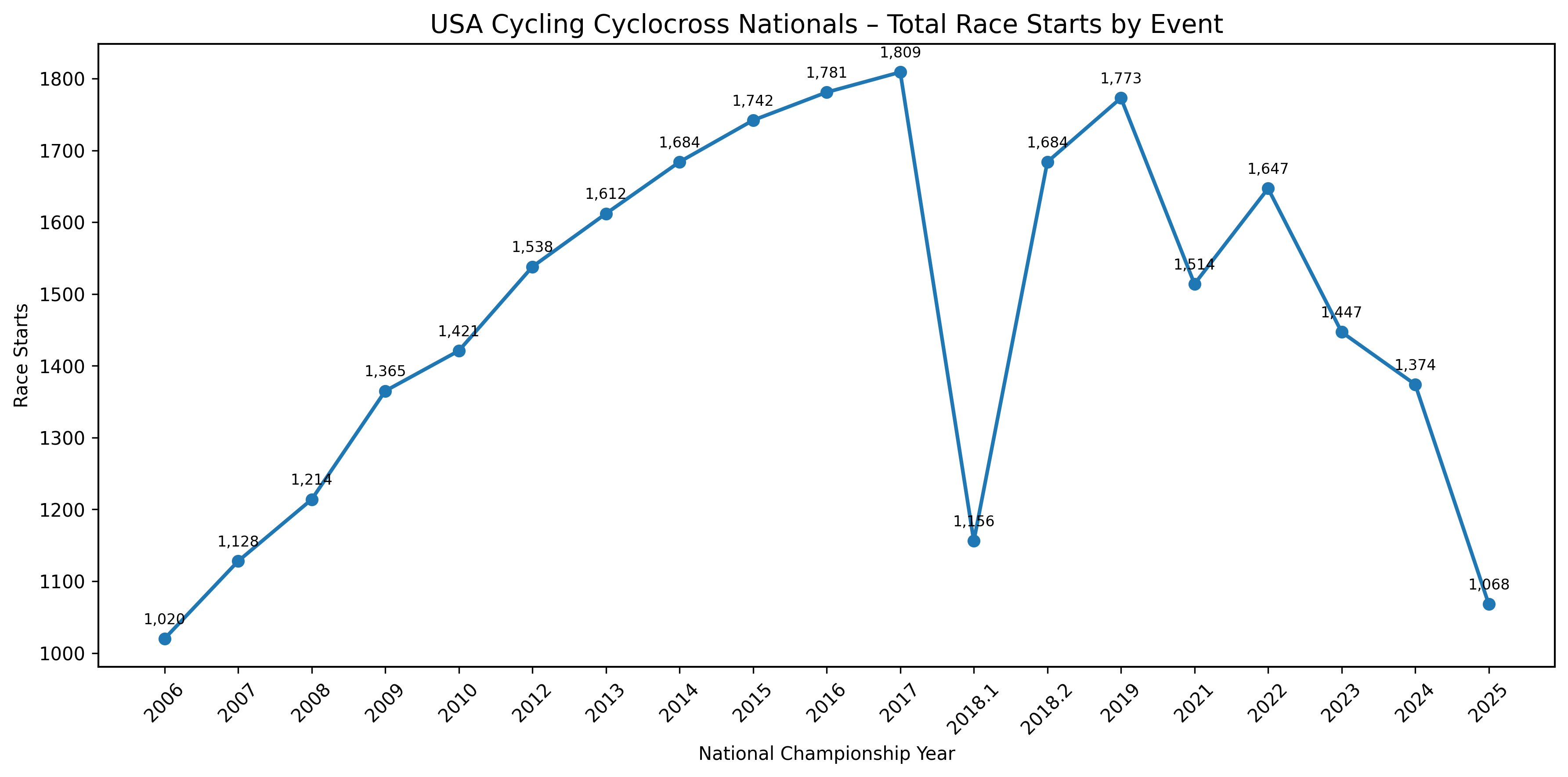
If we are going to talk about the number of large races shrinking, we must also discuss Nationals.
In 2006, Nationals recorded 1,020 race starts in Providence, Rhode Island. Nationals peaked at 1,809 race starts in Hartford in 2017. In 2025, the event drew 1,068 race starts over five days in Fayetteville. That is a drop of 741 starts, or 41 percent, from Hartford to Fayetteville.
2025 was not just down from the peak. It was the second-smallest Nationals, ahead of only Providence in 2006. Fayetteville felt sparse, and the numbers bear that out.
Since 2022, Nationals has been on a slide. The event drew 1,647 race starts in Hartford in 2022, 1,447 in Louisville in 2023, 1,374 in Louisville in 2024, and 1,068 in Fayetteville in 2025. From Hartford 2022 to Fayetteville 2025, that is a decline of 579 starts, or about 35 percent. From 2024 to 2025 alone, the drop was 306 starts, or around 22 percent.
Nationals No Longer Stands Alone
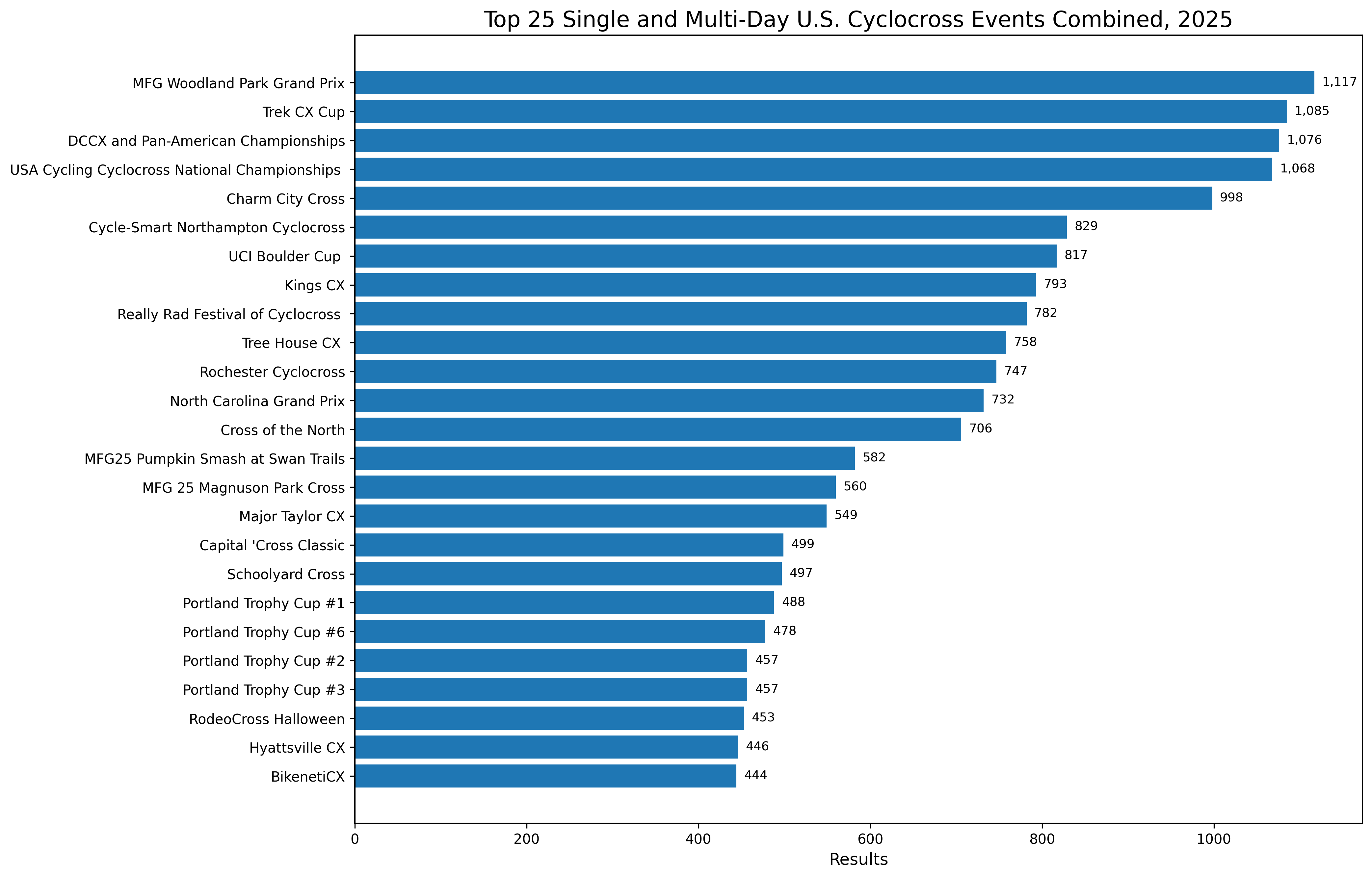
This 2025 event comparison shows how narrow the gap has become. Among the biggest events on the U.S. calendar, Nationals ranked fourth by combined race starts at 1,068 over five days, behind Woodland Park Grand Prix at 1,117, Trek CX Cup at 1,085, and DCCX plus the Pan-American Championships at 1,076. Charm City Cross was close behind at 998. The gap from first to fifth was just 119 starts.
Nationals is still one of the biggest fish in the cyclocross ocean. What it is no longer, at least in this 2025 comparison, is a whale.
Support Your Local Cyclocross Race
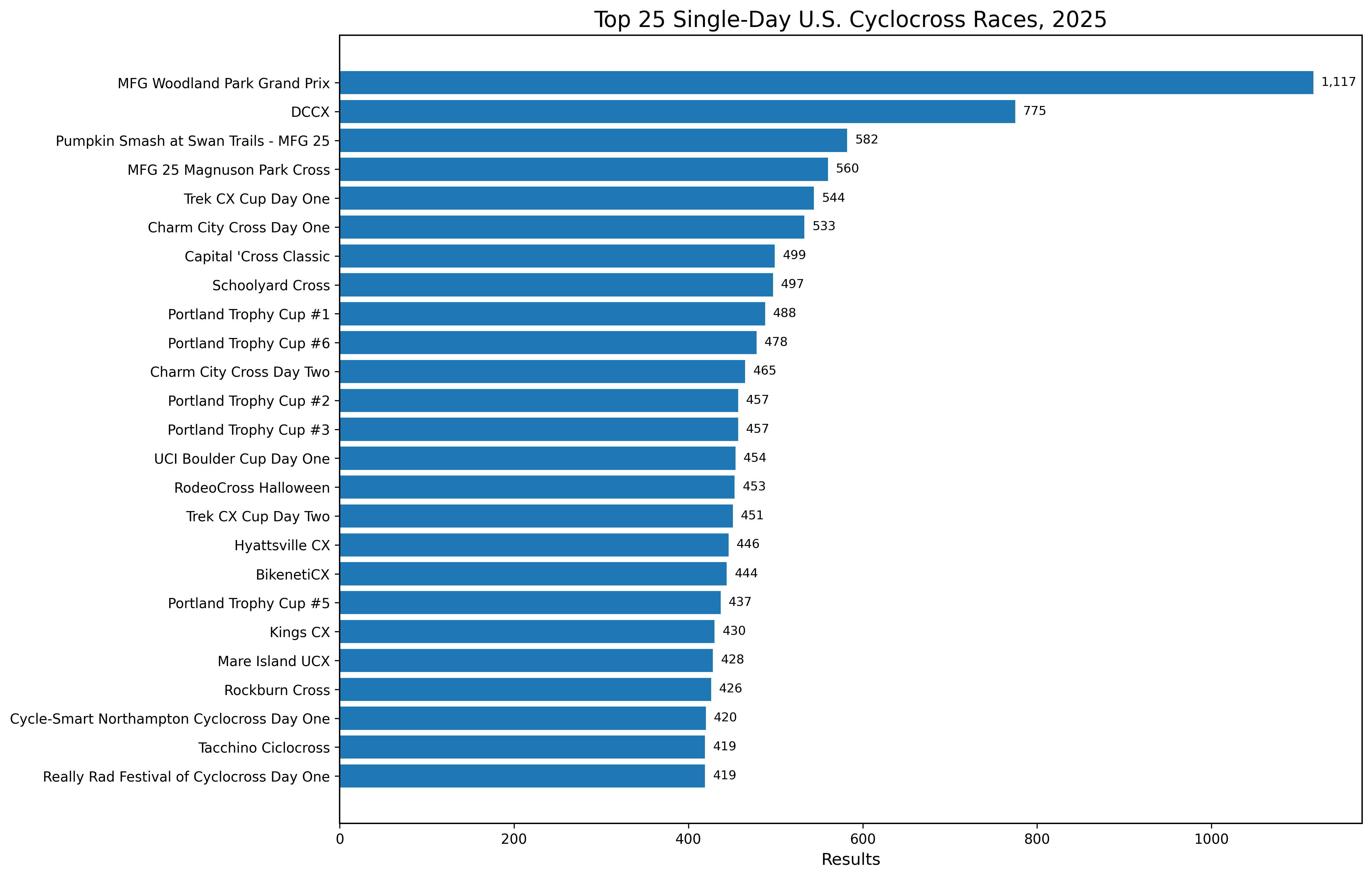
The single-day ranking clearly illustrates the point.
Woodland Park Grand Prix drew 1,117 starts in one day. DCCX drew 775. Pumpkin Smash drew 582. Magnuson Park Cross drew 560. Trek CX Cup drew 544 on day one.
None of the five Nationals race days cracked the top 20 U.S. one-day results. Nationals’ biggest day was 277, ranking just 92nd in U.S. races.
The top five single-day events averaged about 716 starts, roughly two and a half times Nationals’ best race day, and Woodland Park alone saw just over four times Nationals’ best turnout.
This is not a clean apples-to-apples comparison. Nationals is a five-day championship, not a one-day regional race. Still, the numbers are clear: in 2025, regional events—not Nationals—had the highest participation.
Location Location Location
The data does not prove why Fayetteville’s attendance was low. It does not measure travel costs, flight access, local rider density, weather, or the appeal of a host city to a broad amateur base. But Fayetteville’s 1,068 starts were 22 percent below Louisville in 2024 and 35 percent below Hartford in 2022.
At the same time, even established venues draw fewer race starts when revisited. Hartford fell from 1,809 starts in 2017 to 1,647 in 2022. Louisville fell from 1,612 in 2013 to 1,374 in 2024.
The stronger claim is not that Fayetteville alone caused the decline. It is that the sport is already operating from a smaller, more dispersed base, and other factors are at play.
UCI Racing and Nationals
The UCI categories tell a more nuanced story. For this comparison, I’m focusing on 2019 through 2025, when the current UCI championship lineup is fully represented, including U23 Women and Junior Women.
Total Nationals race starts fell from 1,773 in Lakewood in 2019 to 1,068 in Fayetteville in 2025. That is a loss of 705 starts, or nearly 40 percent.
Over the same period, the UCI categories—Elite, U23, and Juniors—fell from 248 starts to 200. That is a loss of 48 starts, or about 20 percent.
The rest of the event fell from 1,525 starts to 868, a drop of about 43 percent.
So just over 93 percent of the total loss between 2019 and 2025 came from outside the UCI championship categories.
That is one of the top takeaways from the Nationals data. The decline is not centered in the UCI fields. The total field is still smaller, but the UCI side of Nationals has held up better than the rest of the event.
In 2019, the UCI championship categories accounted for 14 percent of all Nationals starts. In 2025, they accounted for close to 19 percent. Nationals got smaller, but it also got more concentrated around the UCI side of the event.
Elite Fields On The Decline
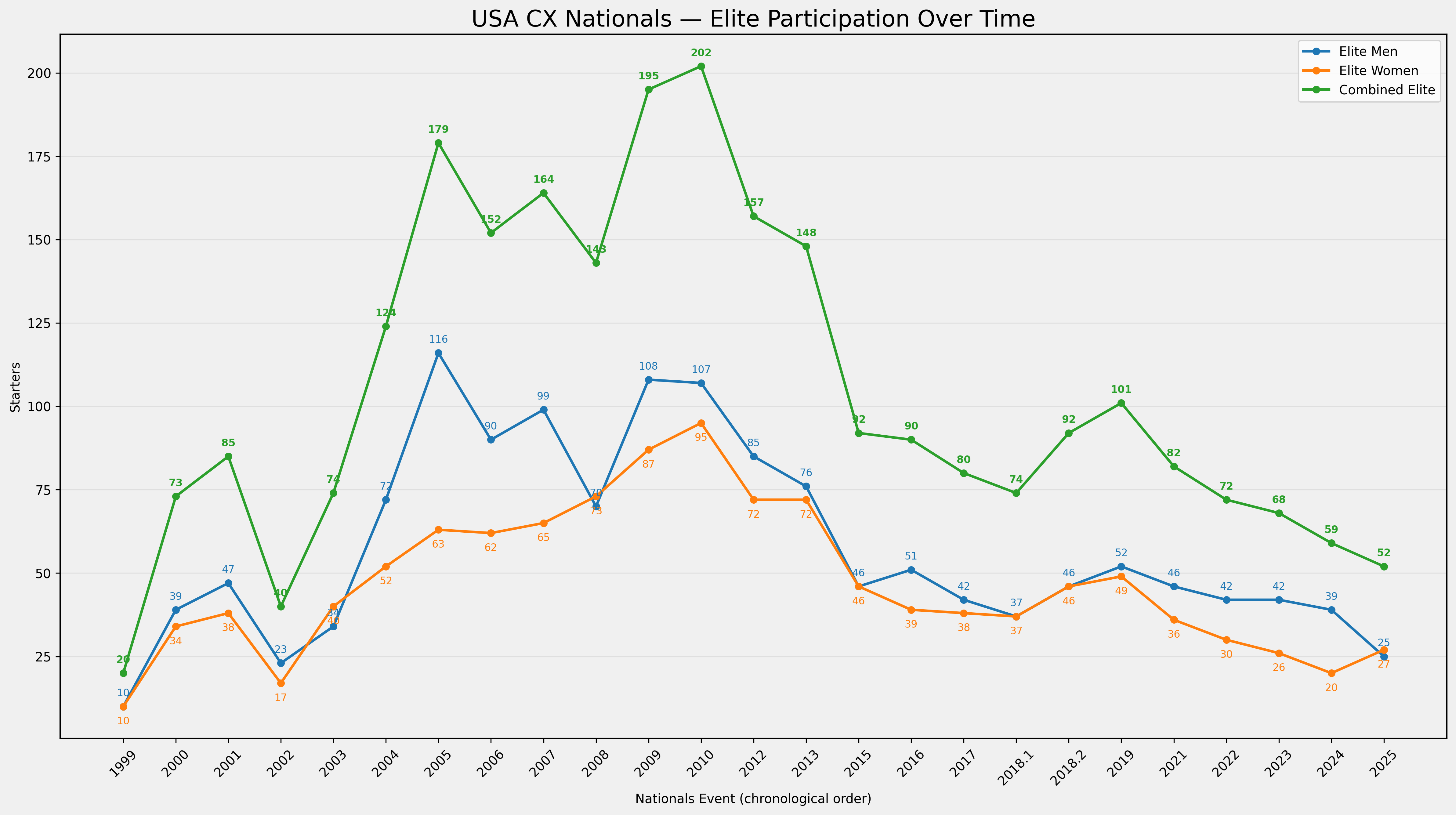
Despite the guarded optimism discussed above about UCI fields not declining as fast as amateur fields, there’s no getting around the fact that the elite-only numbers are bleak. From 2019 to 2025, Elite Men fell from 52 to 25, a 52 percent decline. Elite Women fell from 49 to 27, a 45 percent decline. Combined elite participation fell from 101 to 52, a decline of almost 49 percent.
The wide-angle view is harsher still. Combined elite participation peaked at 202 starters in 2010. It stood at 52 in 2025.
But when the Elite and U23 categories are combined, the decline is smaller. Men’s Elite plus U23 went from 90 starters in 2019 to 84 in 2025, down just about seven percent. Women’s Elite plus U23 went from 64 to 50, down 22 percent. The combined senior championship pool fell from 154 to 134, a 13 percent decline.
That is a meaningful drop, but it is far short of the nearly 40 percent drop in the event as a whole.
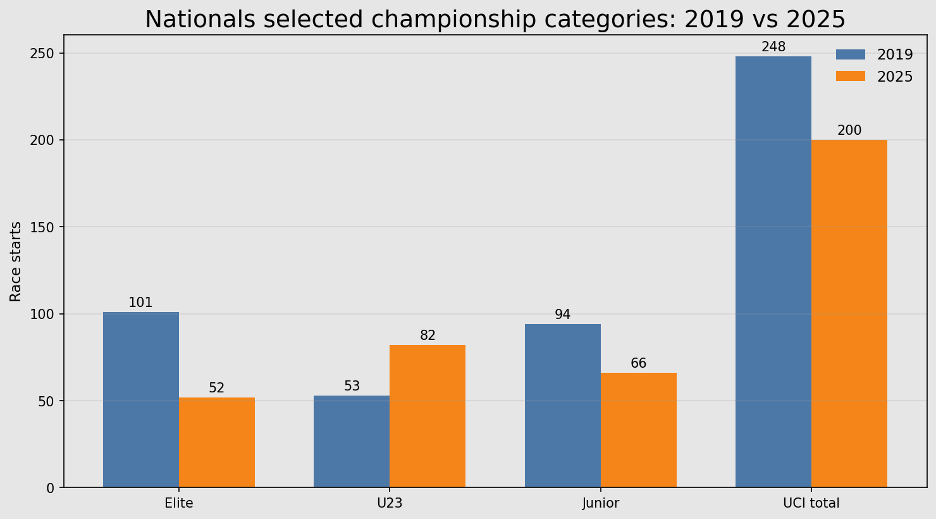
What changed most was composition. U23 Men grew from 38 to 59 between 2019 and 2025, up 55 percent. U23 Women grew from 15 to 23, up 53 percent. In 2019, elite riders accounted for nearly 41 percent of the UCI championship core, while U23 riders accounted for just over 21 percent. By 2025, elites had fallen to 26 percent of the core while U23 had risen to 41 percent.
So while elite depth got much thinner, the broader UCI championship pool shifted younger rather than disappearing.
The Uneven Junior Pipeline
From 2019 to 2025, combined juniors fell from 94 to 66, a decline of nearly 30 percent. Junior Men participation fell from 68 to 41, a decline of almost 40 percent. Junior Women were nearly flat, moving from 26 to 25.
That is not the healthiest pipeline story, but it’s not a wash either. Junior women’s participation held relatively steady while junior men’s participation fell sharply. Overall, the junior base got smaller.
The State of the Sport
That’s a lot of numbers. Hopefully, they help you see the bigger picture of participation in U.S. cyclocross—or spark conversation on your next group ride.
The obvious conclusion from the data is that American cyclocross got smaller, older, and more fragmented. The broader sport still produces real participation, but the top-line numbers are nowhere near the 2015 peak. The age profile has shifted older, the number of marquee race days has collapsed, and Nationals has shrunk sharply, with most of the decline occurring outside UCI categories.
The sport is still here. It’s leaner, more scattered, no longer anchored by thirty-somethings or giant weekends, with Nationals no longer the season’s peak but just another stop.
Cyclocross was up-and-coming two decades ago; there’s nothing stopping it from being that fresh-upstart discipline again.
Let’s chat soon about how to start doing that.
The title “Lies, Damn Lies, and Cyclocross” is a play on the quote “There are three kinds of lies: lies, damned lies, and statistics.” The quote is often attributed to Mark Twain, who may have misattributed it to Benjamin Disraeli and was actually created by British journalist Henry Du Pré Labouchère or British politician Leonard H. Courtney.
(reposting comment from prior version)
Bravo, Bill!
This is excellent, detailed, *critical* work for the sport. Thank you.
"the strongest conclusion from the data is not that American cyclocross got smaller, but that it got older and more fragmented"
This is exactly what we are seeing in Louisville and the Ohio Valley. Empirically speaking in Louisville:
* we have never had more "fast" group rides in the last 20 years
* we've never had the number of bikes on the road
* there are a ton of 20-35 aged riders In Kentucky
* we've rarely had the amount of racing at all disciplines.
* the majority of races are non-USAC and therefore "off the radar"
(( See https://www.uniquelykentuckyracing.com/ for a list all *known* bike races happening in 2026. ))
And yet, we have only 186 USAC licensed racers in Kentucky, and our cyclocross races have plateaued from a post-pandemic bounce.
It's not that the broader support isn't healthy, or that there aren't enough "competitive" riders - it's that (as Twain might say) "the lightning isn't distributed right".
In my group, the Louisville Cyclocross Collective, I press the point with our organization and membership that:
* We are in a very competitive marketplace for rider's attention
* We *must* actively invite new, younger (<35) and female riders
* We have to think differently for this environment
So far, I think it's working.
We topped out at 71 members last year, and just hit 60 in our first spring membership drive.
We'll be hosting 7 days of racing (Short Track MTB and CX) at Bandman this year - with 5 of those days non-USAC to keep barriers (costs) low and the vibes as casual as possible.
And it's not just CX - promoters like Gary Bentley with Kentucky Open Road Racing series just sold out his first event of the season with a very healthy citizen, Cat 5 and female turnout.
A *road race*. In *Kentucky*. Selling out! 🤯
My thesis:
Stop trying to recreate the past, and start adjusting to the now, so you can create the future.
Data and analysis like what you've provided here is so critical to that. 💜
Cheers, Ben Wilson, President
Louisville Cyclocross Collective
https://louisvillecrosscollective.com/
($20 memberships are open now, and we are always looking for partners and donations 😜 )
PNW is really healthy and keeping the west coast on the charts 🙌 & GenX is CX at its core.
Still interesting numbers. Still work to do. Thanks, Bill.